I don’t believe in New Year’s Resolutions, and I don’t believe in shortcuts (at least where changing behavior is concerned-human, horse, or any other living thing).
First off, winter is for wintering. Winter is for being cozy and resting and planning. For those of us in the Northern Hemisphere, January is the middle of winter.
Second, a person can “reset” their life at any time on any day.
And finally, study after study has shown that we’re far more likely to change our habits by changing one small thing at a time on our path to live in a way that best suits our goals.
The same is true of training horses. Each goal, or step, or stage of our horse’s training needs to be broken down into smaller steps.
Let’s take an example: Ground-driving a young horse.
- they need to know how to be led – to follow, to be led from either side, from the shoulder, and even from farther back. (And before they can be led, they need to be okay with a human’s hands on both sides of their face and behind their ears. They need to be okay with those hands putting on a halter. Then, they need to understand the basic idea of pressure and release of pressure – aka, when I ask the horse to move, they move)
- they should know how to lunge – i’m not talking about pushing your horse around in circles until they want to drop, but a nice relaxed gait that is the result of the handler/trainder “sending” the horse forward in a given direction.
- they need a killer “whoa” – when i say WHOA, that horse needs to STOP
- they need to be okay with ropes touching their sides, legs, and back at all gaits and the whoa needs to be present
- they need to be comfortable with a circingle or saddle (this can be broken down into the steps of: a thing on their back that does not move, the weight of that thing, the pressure of a girth, and any wiggly bits of the saddle that may touch them unexpectedly)
- If you plan on ground driving with a halter, you may be ready to start. If you’d like to ground drive with a bit, they need to be comfortable not just with the halter, but a bridle and bit.
- They need to have respect for the whip but not be overreactive-aka, react to the whip in a similar manner to reacting to a person’s touch/pressure.
Suddenly, the simple act of walking on the ground while holding reins becomes a series of small steps, which are far easier for the horse to climb.
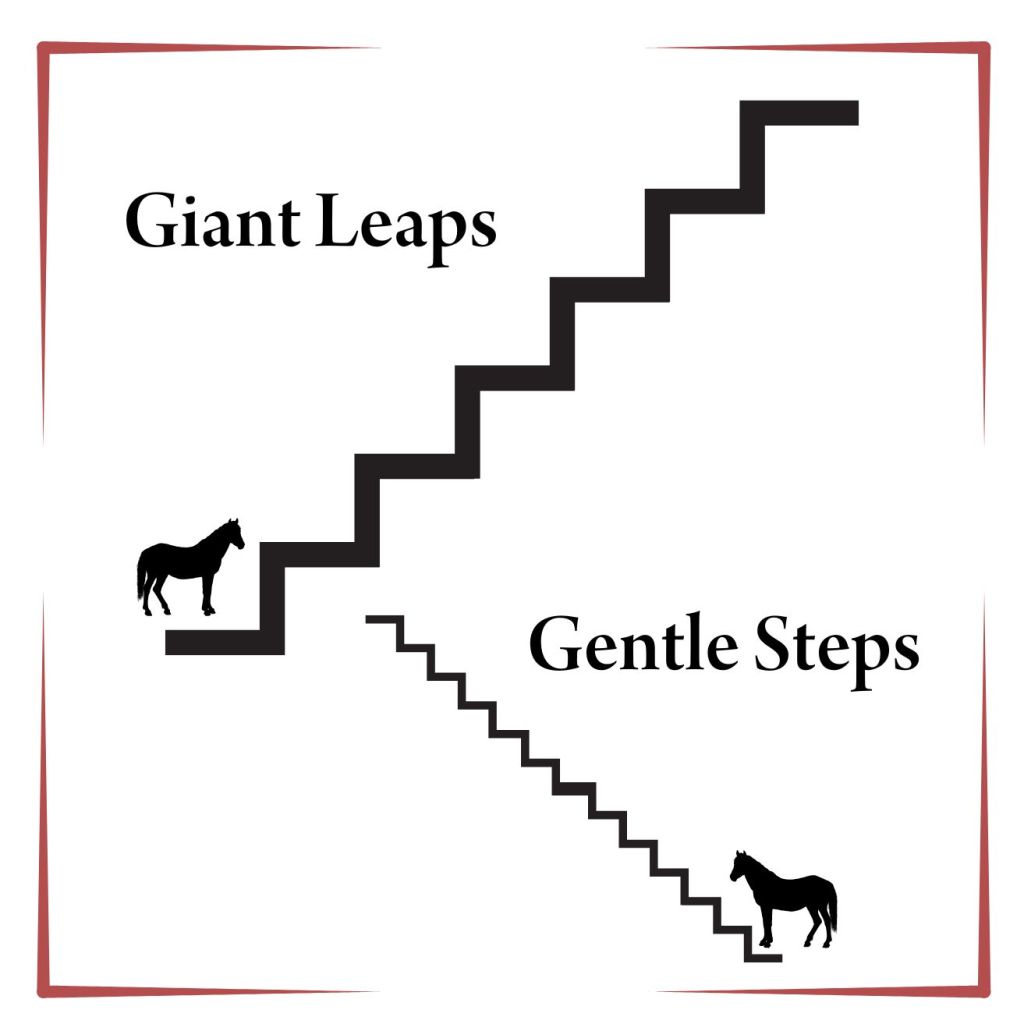
The horse is the same size, coming from the same space, but when they’re allowed to climb one smaller step at a time, you end up a horse who has far fewer “holes” in their training. Feels listened to. Is willing. And not just willing but will work hard for you because they’ve been shown that they’ll be treated fairly.
A long time ago, I had a mare in for training. She came as a sweet and hard-working mare to her new owner and became more and more problematic as time went on.
One of the issues they’d been having was that she was hard to catch and halter – it was not a major concern but more of an afterthought after I’d loaded her to bring her to my place.
This felt like an easy thing to tackle, so we pretended like she’d never been haltered before.
The problem? The mare didn’t like the place behind her ears being touched. That was literally the only issue. Once she realized that a little massage right there feels really nice, she was totally FINE with being haltered. Someone missed one of the steps of putting on a halter: can the horse be touched easily everywhere a halter goes?
Shortcuts are not shortcuts. They’ll get you a horse that can make a sale video and then ruin your reputation. They can get you a horse who shuts down to the point where anything scary makes them stop or freeze (which some take as a fabulous sign) until one day they explode and hurt someone.
I have a horse who hates the horse trailer.
Why?
Because for the first four years of his life, every time he got into a trailer, it was for a LONG HAUL (think cross-country).
So, I’m currently in the process of stepping back to ask myself: How small can I make each step of being trailered?
- be calm around the trailer
- be calm behind the trailer with the door open
- be calm about sniffing the trailer floor
- be calm about stepping front feet inside the trailer
- be calm about staying there for a moment
- be calm when stepping in all four feet
- be calm when asked to stay there for a while
- be calm when the trailer door is closed
- be calm when unloading
- be willing to load back up
- be calm when loading, going for a short drive, and unloading at home, and then re-loading (like we’d do if we went somewhere)
- be calm when loading, go to a new place, unload, and re-load.
- THEN, we can talk about going somewhere, doing some work, and heading back home.
It is colossally unfair of me to shove my gelding in a trailer, take him to a new place, work him, put him back in the trailer and bring him home all in one step. But when I change one thing at a time – letting him stand, loading and unloading at home…he has no excuse to be an idiot about it when we start trailering out to ride.
I will never apologize for taking these small steps. Would I feel the need to take steps this tiny with every horse? Nope. I have a filly who doesn’t mind being in the trailer at all. It’s a very low stress event for her. On her first trailer ride, I took her out at a favorite trail-riding spot and led her like a dog before putting her back in.
My gelding? Just being NEAR the trailer levels up his energy.
Always ask yourself: is there a way to break this task into smaller pieces?
In the end, this is just another reminder that training up a horse, or ourselves, is far more about the journey than the end goal.
~ Jolene
 Compass Line Equestrian LLC
Leave a comment