This bit of information is for horses who have had very little handling, or who have been neglected or abused, and who have come to be trained up for riding.
I’m going to use the SPOON THEORY as a way to showcase why it is crucial to move slowly with these animals.
So, the idea of the spoons is that everyone starts a day with the same number of spoons, but for a person who is in a wheelchair, it may take 3-8 of those spoons to get out of bed and to get dressed, while the average person only needs 1. Or someone with depression may need most of their daily allotment of spoons simply to get themselves to work.
Annnnnd, this means that some people run out of spoons faster than others.
Horses are much the same. Let’s say every horse has 20 spoons of concentration per day.
Horses who have been only lightly handled, or left alone, or left nearly wild/feral (feral really makes them sound edgy, no?), need more spoons for simple tasks.
In other words – a horse in for higher level dressage training likely only needs 1 spoon to be haltered and groomed, while another needs between 12-15 to be haltered and groomed. That upper-level horse still has 19 spoons left to work with. The other horse is now down to 5-8.
Some horses gain MORE spoons by being groomed because they love it! Some lose spoons because that seemingly simple interaction isn’t simple for them.
When a horse reaches their spoon limit, they’re likely to shut down or become dangerous and frustrated. This is why it is crucial to find a trainer who knows how to read a horse so they know how long a horse can be handled, and when to call it quits for the day. Or, when to take a day or two off.
I’d way rather stop a session after something really fab happens, even if I’m ending that session shorter than I wanted. Training goes backward when a person pushes too hard or too long.
This is the main reason why I’d far prefer to work on a horse without the owner for a while before bringing them into the mix. For an upper-level horse, I’d rather have 3-6 weeks before the owner steps in and does the movements. With a young or tricky horse, that time becomes even more crucial.
Now, I’m a big believer in creating horses and riders who can work well together, but sometimes that means I need some solid time to gain the trust and learn to understand the horse the client wants to form a partnership with.
This also means that if I overuse spoons one day, I’m going to want to give that horse a day off. Or a couple of days off. And that’s a very hard thing to grasp when someone is paying to get their horse from point A to point F, or whatever the end goal is. This is also a hard thing to understand when owners just want to come and spend time, because some horses need no spoons for a walk and others need most of their spoons for the day for that very same walk.
The hardest part about teaching this, is that it’s done by feel and experience. When to push and when to back off. When moving forward is what the horse needs, and when they simply need a day off.
But this idea has changed the way I approach working with horses and has led me to be far more in tune with how to move forward. As always, I’m in awe of what I learn from these animals on the daily. It’s why I have so many four-legged friends, and only a few two-legged ones.

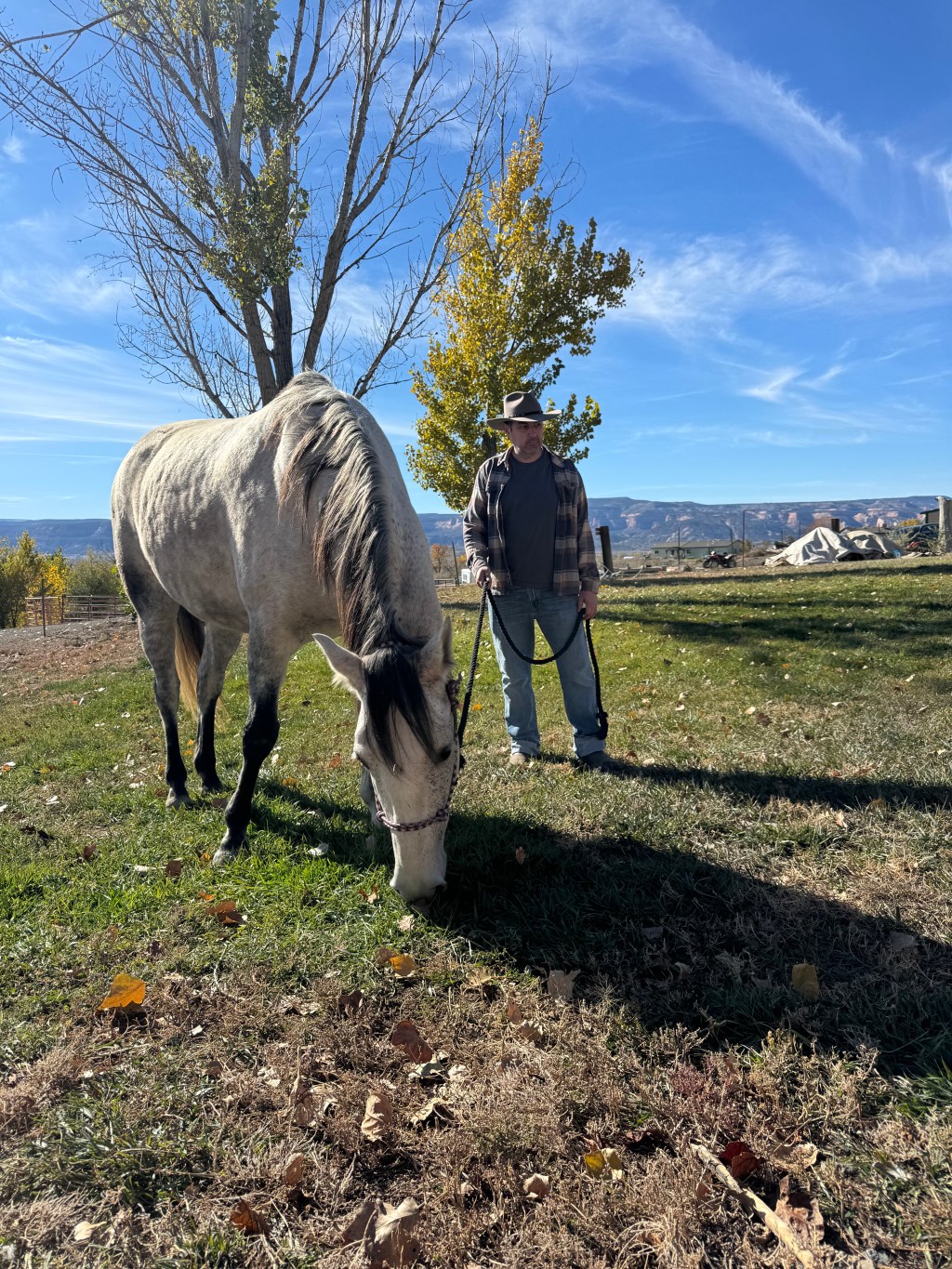
This is a picture of my husband and his Andalusian mare, Eowyn. This is her first day on the farm. For the first two weeks, all we did was hand walk her around and let her get used to her new home. (Almost two months later, and we’re just now moving past that).
No sense in rushing what doesn’t NEED to be rushed. Every part of this life is all about the journey, not the destination. True for horses and humans and everything in between.
~ Jolene
 Compass Line Equestrian LLC
Leave a comment